ADA-403D: Does a Dental Model Need a Cheek?
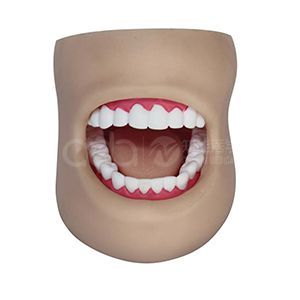
Buy the version with a cheek when the lesson is about the whole mouth — retraction, soft tissue, tongue, both arches — and buy an arch-only model when the lesson is tooth morphology. The ADA-403D is the first kind: a life-size PVC mouth that includes cheek, palate, gums, upper and lower dental arches, tooth crowns and tongue, built to demonstrate tooth form and oral cavity cleaning.
Quick facts
| Item | Detail |
|---|---|
| Model | ADA-403D |
| Category | Teeth models / oral hygiene teaching |
| Material | PVC |
| Format | Life size, with cheek |
| Structures | Cheek, palate, gums, upper and lower dental arch, tooth crowns, tongue |
| Teaching use | Oral hygiene demonstration, tooth form, oral cavity cleaning and protection |
| Price | Quoted per order — request the current price list |
| Certification | ISO 9001 / 14001 / 45001 and CE documentation on request |
What the cheek changes in a lesson
An arch-only model shows teeth in a row. That is the right view for morphology and the wrong view for hygiene, because hygiene happens in a mouth that is partly closed: a cheek retracts, a tongue moves into the field, and the posterior buccal surfaces — where brushing most often fails — sit behind soft tissue.
With a cheek in place, three teaching points become physical rather than verbal:
- Retraction. The student has to move soft tissue to see the field, which is the first manual skill of an oral examination.
- Access. Posterior buccal and lingual surfaces are reachable only at an angle, so the brushing demonstration matches what a patient actually has to do.
- Orientation. Upper and lower arches are seen in occlusion with the tongue in position, so "brush where the cheek meets the gum" stops being an abstraction.
With cheek vs arch-only: the decision table
| Question | Model with cheek (ADA-403D) | Arch-only model |
|---|---|---|
| Shows soft tissue and tongue | Yes | No |
| Best for oral hygiene demonstration | Strong | Weak |
| Best for tooth morphology close-up | Adequate | Strong |
| Retraction and access practice | Yes | No |
| Handling in a classroom | Bulkier, needs two hands | Easy to pass around |
| Storage | Needs a flat tray or case | Drawer-friendly |
| Typical use | Patient education, nursing and dental hygiene teaching | Dental anatomy lectures, morphology exams |
The rule that follows is simple: one with-cheek model per teaching room, plus arch-only models if your syllabus also examines crown anatomy. Buying five with-cheek units to teach morphology spends money on soft tissue you are not teaching that day.
Why a physical mouth still earns its place
Oral disease is not a marginal topic. The Global Burden of Disease analysis ranks untreated caries in permanent teeth among the most prevalent conditions measured worldwide [1], and the wider burden of oral disease — caries, periodontal disease, edentulism — affects an estimated 3.5 billion people [2]. Prevention is delivered by teaching, and teaching is delivered with something the learner can see.
Three-dimensional physical models have a documented advantage over flat images for spatial understanding in anatomy education, with meta-analytic evidence favouring 3D visualisation [3]. In hygiene teaching the mechanism is direct: a chart shows a brushing angle, a model lets the student place the brush at that angle and check it against the gingival margin.
A 40-minute oral hygiene lesson
- 5 minutes — name the structures. Cheek, palate, gums, arch, crown, tongue. Students point, not recite.
- 8 minutes — demonstration. Modified Bass technique on the buccal surfaces, then lingual, then occlusal. One quadrant per pass.
- 10 minutes — paired practice. One student brushes the model, the other checks the angle at the gingival margin and calls corrections.
- 7 minutes — interdental cleaning. Floss or interdental brush on the posterior contacts, where the cheek makes access hardest.
- 5 minutes — teach-back. Each student explains the sequence to a partner in under a minute, as they would to a patient.
- 5 minutes — documentation. One sentence per student on what they would change in their own routine.
What the model does not do
- It is not a pathology model. No caries, no calculus, no gingival inflammation. Teaching disease recognition needs a different product.
- It is not a preparation trainer. No drilling, no cavity design; the PVC is for demonstration, not for bur practice.
- It is not patient-specific. Crown anatomy is didactic rather than a scan of one individual.
- It does not replace a live mouth. The final assessment of brushing technique still happens on a person, under supervision.
Buying notes
- Confirm whether the cheek is fixed or detachable. Detachable cheeks are easier to clean and to demonstrate on; fixed cheeks hold their shape better in handling. Ask before ordering a class set.
- Check the cleaning routine. PVC wipes clean with mild detergent; confirm that the printed detail survives the disinfectant your clinic uses.
- Order one per 10–15 students. It is a demonstration model, not a pass-around unit; below that ratio, buy two.
- Ask for carton dimensions and weight. The cheek adds bulk, and storage planning starts with these two numbers.
- Request a sample unit before a cohort order. Verify colour of gums and the legibility of crown detail against your teaching photographs.
FAQ
Q1. What is included in the ADA-403D?
A life-size PVC model of the mouth showing cheek, palate, gums, upper and lower dental arches, tooth crowns and tongue, mounted for demonstration.
Q2. Is it suitable for teaching brushing technique?
Yes. It is designed to demonstrate tooth form and oral cavity cleaning, and the cheek makes posterior buccal surfaces realistic to reach.
Q3. Can it be used for cavity preparation practice?
No. It is a demonstration model in PVC, not a phantom head or a preparation trainer.
Q4. What is the price and minimum order?
MOQ is flexible and quoted per order. Email with quantity and destination for the current price list and volume tiers.
Q5. How is it cleaned between classes?
Wipe with mild detergent and water, then dry. Confirm the disinfectant you use is compatible with printed PVC detail before adopting it across a course.
Q6. How do we request a quotation or a sample?
Email chinonplus@adaanatomy.com with quantity, city and the course it supports; you will receive pricing, packing data and lead time.
References
- Bernabé E, Marcenes W, Hernandez CR, et al. Global, regional, and national levels and trends in burden of oral conditions from 1990 to 2017: a systematic analysis for the Global Burden of Disease 2017 study. J Dent Res. 2020;99(4):362-373. doi:10.1177/0022034520908533
- Peres MA, Macpherson LMD, Weyant RJ, et al. Oral diseases: a global public health challenge. Lancet. 2019;394(10194):249-260. doi:10.1016/S0140-6736(19)31146-8
- Yammine K, Violato C. A meta-analysis of the educational effectiveness of three-dimensional visualization technologies in teaching anatomy. Anat Sci Educ. 2015;8(6):525-538. doi:10.1002/ase.1510
Contact
For the specification sheet, cheek configuration and a class-size quotation: chinonplus@adaanatomy.com. Production follows ISO 45001 management practice; CE documentation is available for EU procurement.