BIX-LV46 Vascular Separation and Ligation Model: Setting Up a Skills Station
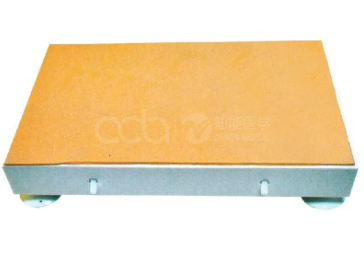
Quick answer. The BIX-LV46 is a flat training pad with a clearly layered skin module and realistic tissue tension, built for blood vessel separation, cutting and ligation practice and assessment. It replaces animal tissue in the early phase of a surgical skills course at a fraction of the cost.
Ligation is taught in the first weeks of surgical training and assessed for the rest of a career. The problem is that the skill is usually learned on whatever tissue is available, which makes practice irregular and assessment subjective. A standardised pad solves both: every student meets the same resistance, the same vessel calibre and the same layers.
What the pad provides
| Feature | Detail | Teaching consequence |
|---|---|---|
| Layered skin module | Distinct layers with real tissue tension | Students learn to identify the plane before cutting |
| Vessel target | Consistent calibre and depth | Ligation technique is comparable between students |
| Construction | Economical, durable, reusable surface | Enough repetitions per student within one course |
| Use | Separation, cutting, ligation — training and assessment | One surface serves both practice and examination |
A four-stage progression
- Identify the plane (10 min). Students separate the layers bluntly, without cutting, and name each layer they pass. Most errors happen here, not at the knot.
- Isolate the vessel (10 min). Pass the instrument around the vessel without damaging it. Time the exercise; speed without control is the wrong target.
- Ligate (15 min). Two ties, correct tension, no slip. Ask for a square knot, then a surgeon's knot, and compare security.
- Assess (10 min). Score with a simple rubric: plane preserved, vessel intact, tie secure, instrument handling, time. Video the attempt if the pad allows it.
Simulation curricula for vessel ligation have been described in the surgical education literature, with adaptive programmes that adjust task difficulty to learner performance [1]. Technical evaluation of ligation performance has also been studied using crowdsourced assessors, which supports using a rubric rather than a single examiner impression [2]. Force-feedback simulators have been shown to improve knot-tying proficiency, and the same principle applies here: the pad gives consistent haptic resistance, which is what a learner needs in order to calibrate tension [3].
What the pad cannot teach
- Bleeding and field contamination. No perfused vessel, so haemostasis under pressure is not trained.
- Tissue variability. Real tissue varies with age and pathology; the pad is standardised by design.
- Deep cavity access. This is a surface trainer. Cavity work needs a box trainer or cadaver.
- Energy devices. The pad is for sharp dissection and suture ligation only.
Use the pad for the first two weeks and move students to perfused or cadaveric models once the tie is reliable. Keep the pad for assessment: standardisation is exactly what an examination needs.
Procurement notes
- Confirm the layer structure of the consumable module, and whether replacement modules are sold separately.
- Ask for the pad dimensions and weight; a flat pad is easier to store than a torso trainer.
- Request the unit price at course volume — this is a consumable-led purchase, not a one-off capital item.
- Factory certification: ISO 9001, ISO 14001 and ISO 45001.
Quotation. Module pricing and course-volume discounts for the BIX-LV46 are available from chinonplus@adaanatomy.com; state your annual number of trainees so the consumable estimate is realistic.
FAQ
Q1. What procedures can be practised on the BIX-LV46? Blood vessel separation, cutting and ligation, for both training and assessment.
Q2. Is the pad reusable? The surface is durable and can be used repeatedly, but the layered module is a consumable. Ask for the replacement price when ordering.
Q3. How does it compare with animal tissue? It is more consistent and cheaper, but it does not bleed. Use it for technique and assessment, then move to perfused tissue.
Q4. Is it suitable for assessment? Yes. Because every pad is identical, scoring is comparable between students and between cohorts.
Q5. What else is needed at the station? Basic instrument set, suture, a tray and a timer. No power or water supply is required.
Q6. Can it be used for open and laparoscopic practice? It is a surface (open) trainer. Laparoscopic work needs a box trainer with camera and ports.
Product page: BIX-LV46 Vascular Separation and Ligation Model: Setting Up a Skills Station — specification, packing data and a quotation request form.
References
- Hu Y, et al. Vessel ligation training via an adaptive simulation curriculum. J Surg Res. 2015;196(1):17–22. doi:10.1016/j.jss.2015.01.044
- Hu Y, et al. Vessel ligation fundamentals: a comparison of technical evaluations by crowdsourced nonclinical and expert raters. J Surg Educ. 2018;75(3):664–670. doi:10.1016/j.jsurg.2017.09.030
- Hsu JL, et al. Force feedback vessel ligation simulator in knot-tying proficiency training. Am J Surg. 2016;211(2):411–415. doi:10.1016/j.amjsurg.2015.09.009
For module pricing or a course-volume quotation on the BIX-LV46, write to chinonplus@adaanatomy.com.